Econometrics Puzzler #2: Fitting a Regression with Fitted Values
Suppose I run a simple linear regression of an outcome variable on a predictor variable. If I save the fitted values from this regression and then run a second regression of the outcome variable on the fitted values, what will I get? For extra credit: how will the R-squared from the second regression compare to that from the first regression?
1 Example: Height and Handspan
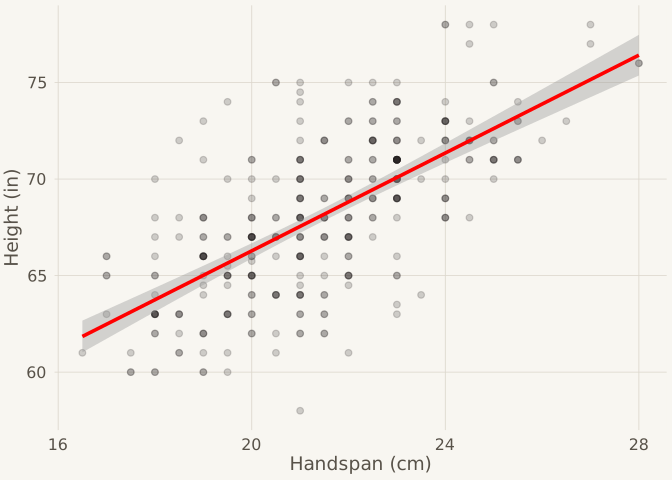
Here’s a simple example: a regression of height, measured in inches, on handspan, measured in centimeters.1
1 In case you don’t know what handspan is: stretch out your dominant hand, and measure from the tip of your thumb to the tip of your pinky finger. This is your handspan. I collected this dataset from many years of Econ 103 classes at UPenn. ↩︎
library(tidyverse)library(broom)dat <-read_csv('https://ditraglia.com/data/height-handspan.csv')ggplot(dat, aes(y = height, x = handspan)) +geom_point(alpha =0.2) +geom_smooth(method ="lm", color ="red") +labs(y ="Height (in)", x ="Handspan (cm)")
# Fit the regressionreg1 <-lm(height ~ handspan, data = dat)tidy(reg1)
As expected, bigger people are bigger in all dimensions, on average, so we see a positive relationship between handspan and height. Now let’s save the fitted values from this regression and run a second regression of height on the fitted values:
dat <- reg1 |>augment(dat)reg2 <-lm(height ~ .fitted, data = dat)tidy(reg2)
The intercept isn’t quite zero, but it’s about as close as we can reasonably expect to get on a computer and the slope is exactly one. Now how about the R-squared? Let’s check:
The R-squared values from the two regressions are identical! Surprised? Now’s your last chance to think it through on your own before I give my solution.
2 Solution
Suppose we wanted to choose \(\alpha_0\) and \(\alpha_1\) to minimize \(\sum_{i=1}^n (Y_i - \alpha_0 - \alpha_1 \widehat{Y}_i)^2\) where \(\widehat{Y}_i = \widehat{\beta}_0 + \widehat{\beta}_1 X_i\). This is equivalent to minimizing \[
\sum_{i=1}^n \left[Y_i - (\alpha_0 + \alpha_1 \widehat{\beta}_0) - (\alpha_1\widehat{\beta}_1)X_i\right]^2.
\] By construction \(\widehat{\beta}_0\) and \(\widehat{\beta}_1\) minimize \(\sum_{i=1}^n (Y_i - \beta_0 - \beta_1 X_i)^2\), so unless \(\widehat{\alpha}_0 = 0\) and \(\widehat{\alpha}_1 = 1\) we’d have a contradiction!
Similar reasoning explains why the R-squared values for the two regressions are the same. The R-squared of a regression equals \(1 - \text{SS}_{\text{residual}} / \text{SS}_{\text{total}}\)\[
\text{SS}_{\text{total}} = \sum_{i=1}^n (Y_i - \bar{Y})^2,\quad
\text{SS}_{\text{residual}} = \sum_{i=1}^n (Y_i - \widehat{Y}_i)^2
\] The total sum of squares is the same for both regressions because they have the same outcome variable. The residual sum of squares is the same because \(\widehat{\alpha}_0 = 0\) and \(\widehat{\alpha}_1 = 1\) together imply that both regressions have the same fitted values.
Here I focused on the case of a simple linear regression, one with a single predictor variable, but the same basic idea holds in general.